
|
Last week, Capes Sokol’s Litigation Group outlined some potential significant changes to Missouri’s joinder and venue laws (Senate Bill No. 7).
In this second of a multi-part series, we discuss Senate Bill No. 224, which would enact key provisions of the Missouri Supreme Court Rules regarding discovery to align them more closely with the Federal Rules of Civil Procedure (“FRCP”).
Three major proposed revisions to Rule 56.01 are:
The revised Rule 57.01(a) would limit parties to 25 written interrogatories, including discrete sub-parts. Rule 59.01(a) would also limit parties to 25 requests for admission; requests for admission may be sought regarding the genuineness of documents without limit.
Per the revised Rule 57.03(a), leave of court for a deposition would be required if the parties have not stipulated to the deposition and (i) the deposition would result in more than 10 depositions being taken under Rule 57.03 or Rule 57.04 by any party; (ii) the deponent has already been deposed in the case; or (iii) the plaintiff seeks to take a deposition prior to the expiration of 30 day after service of the summons and petition upon any defendant. The exception to the later would remain if a defendant has served a deposition notice or otherwise sought discovery.
Like FRCP 30(d), Rule 57.03(b)(5) as proposed would limit the duration of depositions to 1 day of 7 hours, absent leave of court or stipulation of the parties. The Court could allow additional time “consistent with Rule 56.01 if needed to fairly examine the deponent or if the deponent, another person, or any other circumstance impedes or delays the examination.” Should a person impede, delay, or frustrate the fair examination of a deponent, the Court could impose on that person an appropriate sanction, including reasonable expenses and attorney’s fees incurred by any party.
Rule 58.01(a)(1)(A) would be revised to include ESI in the scope of documents to be discoverable. A party may per Rule 58.01(b)(1)(C) specify in its requests for production that ESI is to be produced in native format. In objecting to requests for production, the responding party must specify what information is being withheld based on the objection and permit inspection of the remainder.
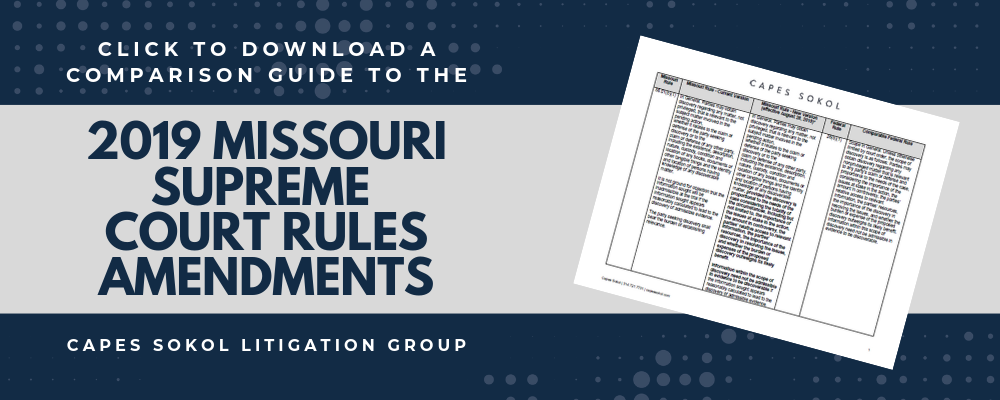
For your reference, we have summarized the proposed revisions to the Missouri Supreme Court Rules and how they would compare to the current Federal Rules of Civil Procedure. If signed into law, these revisions will take effect on August 28, 2019.
Senate Bill 224 seeks to bring the Missouri Supreme Court Rules at least partially up to date with the 2015 amendments to the Federal Rules of Civil Procedure. The amendments would limit the scope of discovery by requiring the discovery sought be proportional to the needs of the case and quantifying how much written discovery can be served and the number and length of depositions.
In analyzing Senate Bill 224’s proposed amendments with regard to ESI specifically, we were reminded of the adage “better late than never.” Should Senate Bill 224 be signed into law, the Missouri Supreme Court Rules would expressly address discovery of ESI for the first time. Parties and courts in Missouri have encountered ESI for years, albeit with no guidance from the Missouri Supreme Court Rules. Yet, FRCP 26(b)(2) – the basis for the proposed Rule 56.01(b)(3) – was amended in 2006 to address issues raised by difficulties in locating, retrieving, and providing discovery of ESI. See Fed. R. Civ. P. 26(b)(2) Advisory Committee Notes. A more proactive approach must be taken in the future to keep the Missouri Supreme Court rules up to date with this developing area of law.
In the third installment of this series, Capes Sokol’s Litigation Group will discuss Senate Bill No. 224’s inclusion of a claw back procedure for the production of privileged or trial preparation materials and its implications on discovery practice.
| The choice of a lawyer is an important decision and should not be based solely upon advertisements. |